
Understanding the Times
In the Image of God, Sent into the World
Artificial Intelligence, the Great Commission and the Christian Calling to Faithful Presence
Mark J. Finlay, FRICS, MAPM · October 2026
Download PDF ↓
EDITORIAL INTRODUCTION
At Leaders & Followers Foundation, we seek to help those entrusted with responsibility understand the times and know what to do—grounded in the truth of Jesus Christ, faithful in prayer, present in relationship and courageous in the pursuit of peace and reconciliation.
In recent weeks, the men of Come Further Up, Come Further In!—our fellowship gathering in the Whiskey Room at Henry’s on the Market in Charleston—have been digging deeply into some of the thornier questions surrounding artificial intelligence, human dignity, wisdom and Christian responsibility. With open Bibles, honest questions and a willingness to challenge one another, we have been asking not only what this technology might do to our world, but what followers of Jesus Christ ought to do with it.
The conversation extends far beyond the Whiskey Room. Artificial intelligence is reshaping government, business, education, communication and the lives of those we are called to serve. It presents genuine dangers, but also extraordinary opportunities to advance the Great Commission, equip disciples, defend human dignity and love our neighbours.
Our response must be neither uncritical enthusiasm nor fearful withdrawal.
We are called to remain faithfully present in the world—and to use whatever tools are entrusted to us in the service of Christ and others.
In Whose Image?
We are living through an extraordinary moment in human history.
Artificial intelligence is changing the way we gather information, interpret evidence, communicate ideas, conduct business and exercise power. It is increasingly capable of producing language, images, music, analysis and recommendations that only a short time ago would have seemed the exclusive province of human intelligence.
Some celebrate these developments as the beginning of a new era of human flourishing. Others fear the erosion of employment, privacy, truth, relationships and even human autonomy.
Both responses contain legitimate concerns.
But for Christians, the most important question may be neither what artificial intelligence can accomplish nor how powerful it may become.
It is a much older question.
In whose image are we made?
The opening chapter of Genesis tells us that God created humanity in His own image (Genesis 1:26–27, ESV).
This is not merely an assertion about our origins. It establishes something fundamental about our identity, dignity and responsibilities.
Human beings are not valuable because of their intelligence, productivity, economic usefulness or capacity to process information.
We possess dignity because we are created in the image of God.
That dignity belongs equally to the brilliant scientist and the child who cannot speak; to the powerful leader and the person whom society has forgotten; to those whose minds remain sharp and those whose memories are fading.
No technological achievement can confer that dignity. Nor can technological progress take it away.
Artificial intelligence may imitate aspects of human reasoning, communication and creativity. It may eventually perform many intellectual tasks more effectively than we can.
But human worth has never depended upon outperforming a machine.
And the biblical understanding of humanity is far richer than intelligence alone.
We are created for relationship—with God, with one another and with the world entrusted to our care.
We are moral beings, accountable for our choices. We are capable of love, sacrifice, worship, forgiveness and reconciliation.
We are also creatures of limitation and dependence.
That last truth is particularly important in an age increasingly captivated by the possibility of technological self-sufficiency.
The Garden: Knowledge Without Wisdom
The story of humanity’s first temptation in Genesis 3, ESV is strikingly relevant.
The serpent does not begin by inviting Adam and Eve to abandon knowledge. Instead, the temptation is bound up with the promise of becoming like God.
Knowledge is presented as a pathway to independence from the Creator.
The problem is not knowledge itself. Scripture repeatedly commends learning, understanding and wisdom.
The problem arises when knowledge becomes detached from obedience, humility and trust in God.
Artificial intelligence places unprecedented quantities of information and analytical capability within reach of individuals and institutions.
That is a remarkable achievement.
But more information does not necessarily produce better judgment. Greater capability does not automatically produce greater virtue.
A government may possess extraordinary intelligence yet lack wisdom. A corporation may develop astonishing technologies yet fail to consider their consequences. An individual may have access to almost limitless information and still struggle to distinguish truth from falsehood.
The question is not simply what we can know.
It is whether we have the wisdom to know what we ought to do.
Proverbs reminds us that the fear of the Lord is the beginning of knowledge (Proverbs 1:7, ESV).
It is an uncomfortable proposition for an age that increasingly assumes human progress can be measured by the expansion of our technical capabilities.
But it remains an essential distinction.
Intelligence is not wisdom. Capability is not character. And knowledge is not the same as truth.
Babel: The Ambition to Reach Heaven
The Tower of Babel in Genesis 11, ESV introduces another warning.
Human beings discover the power of collective organization and technological innovation. They possess a common language, shared ambition and the ability to build on a scale previously unimaginable.
Their objective is revealing: to make a name for themselves.
The story is not a condemnation of architecture, engineering or human cooperation.
Rather, it exposes the danger of collective ambition detached from humility before God.
The builders of Babel sought to establish their own greatness and security.
Our age has its own extraordinary towers.
They may take the form of vast data centres, computing infrastructure, increasingly sophisticated algorithms and systems capable of influencing decisions across entire societies.
These achievements are not inherently wrong.
Indeed, they may contribute greatly to human flourishing.
But we should be cautious when the language surrounding technology begins to suggest that humanity can overcome every limitation, solve every moral problem or ultimately transcend its own nature.
The question is not whether we should build.
It is why we build, for whom we build, and to whom we believe ourselves accountable.
A tower may be an expression of service.
Or it may become a monument to human pride.
The Word, the Printing Press and the Machine
Christians have encountered technological revolutions before.
Around 1455, Johannes Gutenberg produced his celebrated Bible in Mainz using movable metal type.
The Gutenberg Bible became one of the defining achievements in the history of printing. It demonstrated how Scripture could be reproduced with a consistency and efficiency previously unattainable through manuscript copying alone.
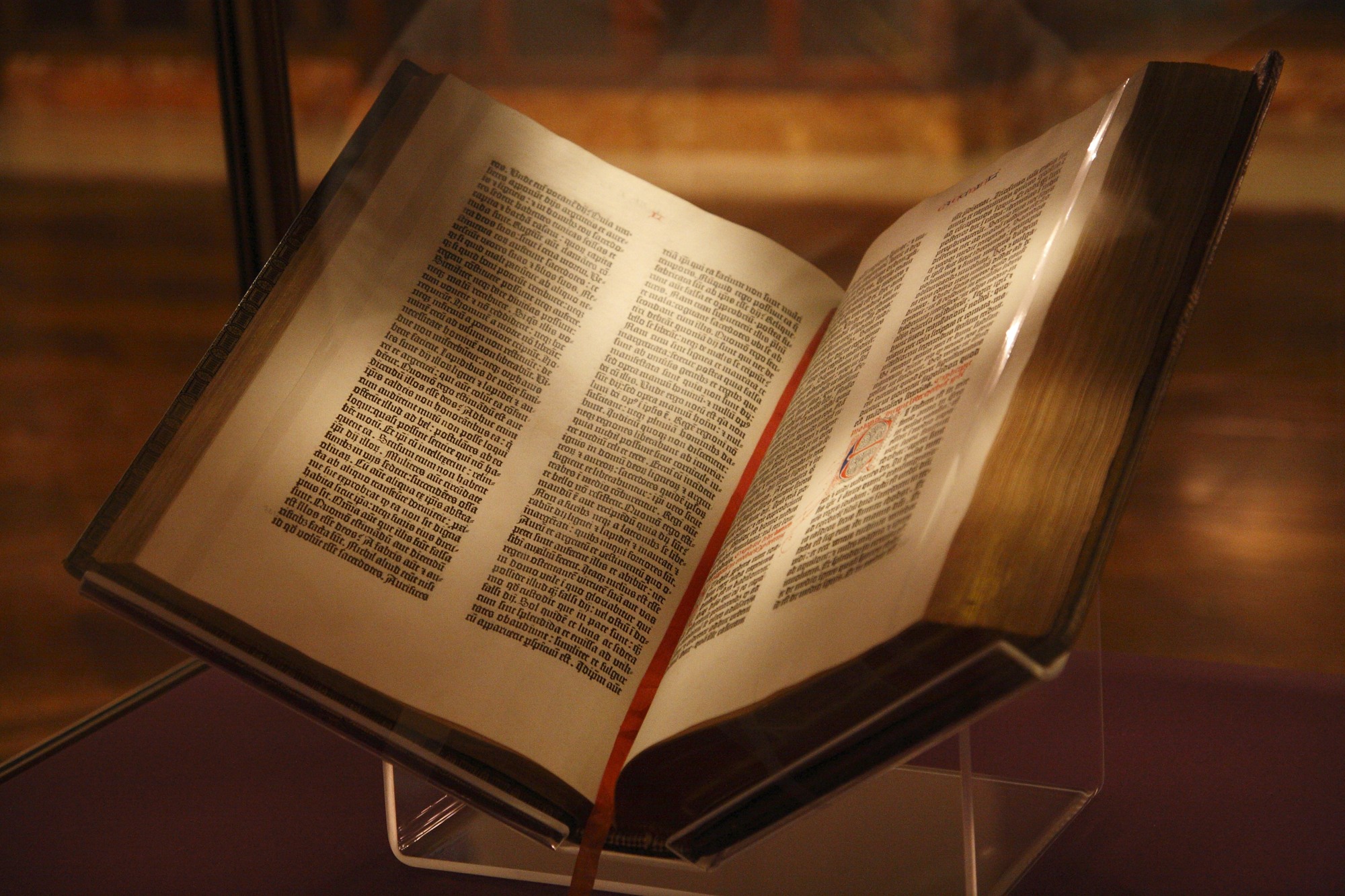

Over subsequent generations, printing helped transform the circulation of Scripture, religious teaching and ideas across Europe.
The Reformation, the spread of vernacular Bibles and the expansion of literacy would all become closely associated with the new possibilities of print.
Centuries later, radio carried Christian teaching into homes and across borders.
Television brought preaching, worship and religious discussion to audiences far beyond the reach of individual congregations.
The internet enabled people almost anywhere to read Scripture, access teaching, join conversations and participate remotely in Christian communities.
These developments brought extraordinary opportunities.
But we should not romanticize their history.
Some television evangelists recognized not only the enormous reach of broadcasting but its potential as a fundraising instrument.
In certain ministries, appeals for money became so prominent that they threatened to overshadow the proclamation of the Gospel itself. Some appeals exploited the hopes and fears of vulnerable people—those facing illness, loneliness, poverty or desperation.
We should acknowledge the genuine good accomplished through Christian broadcasting without overlooking its abuses. Nor should we presume to know the motives of every broadcaster.
Yet the pattern is sufficiently familiar to warrant serious reflection.
As religious communication migrated to websites, social media, livestreaming and digital platforms, the means of reaching people changed dramatically.
The temptation to exploit them did not.
The medium changes. The temptation to exploit human vulnerability remains.
The Apostle Paul warned against those who would peddle the word of God for profit (2 Corinthians 2:17, ESV).
It was a problem long before television.
Artificial intelligence may magnify both the opportunities and the dangers.
It can help communicate Christian teaching across linguistic boundaries, support accessibility, prepare educational resources and connect people who might otherwise remain isolated.
But it can also personalize persuasive appeals, identify vulnerabilities, manufacture apparent intimacy and automate communications at extraordinary scale.
The Church must ask not merely whether technology can increase its reach, but whether its use reflects the character of Jesus Christ.
The Great Commission is not a commission to maximize engagement, accumulate followers or build an audience.
It is a commission to make disciples.
The technology may assist the work. It must never become the object of the work.
The Cupbearer and the Question of Wisdom
The book of Nehemiah, ESV offers an instructive example for an age increasingly preoccupied with intelligence and power.
Nehemiah served as cupbearer to Artaxerxes, King of Persia.
His was a position of unusual trust and proximity to authority. He understood the workings of the court and occupied a place from which he could eventually influence events far beyond the palace.
Yet when news reached him of Jerusalem’s broken walls and the suffering of its people, his first response was not to devise a strategy or seek an audience with the king.
He sat down and wept.
He mourned, fasted and prayed.
Only then did he act.
Nehemiah reminds us that possessing information does not itself confer wisdom. Nor does proximity to power establish moral authority.
In an age when artificial intelligence can assemble extraordinary quantities of information in seconds, this distinction becomes more important, not less.
Our calling at Leaders & Followers Foundation has long been shaped by the example of the cupbearer: to be faithfully present alongside those entrusted with responsibility, to pray before speaking, to listen before advising, and to seek the welfare of others rather than prominence for ourselves.
It is a calling that crosses the boundaries of political parties, nations, institutions and denominations.
Artificial intelligence may help leaders understand a problem. It may compare alternatives, examine evidence and illuminate consequences.
But it cannot remove their responsibility to act justly, exercise humility and seek wisdom.
And it cannot pray for them.
That remains our calling.
A Technology That Cannot Pray for Us
Christians must also resist a subtler danger: allowing the extraordinary convenience of artificial intelligence to weaken our dependence upon God.
We can ask a machine to summarize Scripture, assemble a theological argument, prepare a Bible study or suggest words for a prayer.
Some of these may be useful aids.
But generating the language of prayer is not the same as praying.
Prayer is not principally the production of eloquent sentences.
It is communion with the living God.
It involves worship, confession, thanksgiving, intercession, listening and surrender.
For years, friends of Leaders & Followers Foundation have gathered regularly to pray for those serving in government and public life.
We do so not because we possess privileged knowledge of what those leaders should do, but because we recognize our own dependence upon God.
We pray for wisdom, justice, peace and the welfare of those whom leaders are called to serve.
The instruction in 1 Timothy 2:1–4, ESV to pray for all people, including those in authority, remains foundational to this ministry.
Artificial intelligence may help us become better informed about the matters for which we pray.
It may help us understand the complexity of a conflict, the implications of a policy or the needs of a community.
But it must never persuade us that we have become less dependent upon the One to whom we pray.
The ability to generate answers is not the same as the wisdom to seek God.
Blessed Are…
The question facing Christians is not simply whether artificial intelligence is safe, useful or dangerous.
It is whether we will approach one of the most consequential technological developments of our age as spectators, critics, consumers—or as disciples of Jesus Christ.
In the Sermon on the Mount, Jesus begins not with a strategy for influence but with a description of the character of those who belong to His Kingdom (Matthew 5:1–12, ESV).
The poor in spirit.
Those who mourn.
The meek.
Those who hunger and thirst for righteousness.
The merciful.
The pure in heart.
The peacemakers.
Those persecuted for righteousness.
These are not qualities that can be manufactured by an algorithm.
A machine may explain mercy. It cannot thereby become merciful in the sense Jesus commands of His disciples.
It may generate eloquent language about peacemaking, but the difficult work of reconciliation still requires people willing to listen, forgive, speak truth and sometimes bear considerable personal cost.
Yet artificial intelligence may help those people in their calling.
It can assist the translation of teaching into languages that might otherwise remain underserved.
It can help churches prepare educational materials, make resources accessible to people with disabilities, understand unfamiliar cultures and communicate across borders.
It may help identify needs, coordinate humanitarian assistance, support education and equip people serving communities with limited resources.
The test is not whether the technology is impressive.
The test is whether its use serves the purposes and reflects the character of the Kingdom.
Salt and Light
Jesus tells His disciples that they are the salt of the earth and the light of the world (Matthew 5:13–16, ESV).
Notice that He does not call them to become salt and light only when circumstances are favourable, or when the surrounding culture already agrees with them.
Their calling is to be present, visible and faithful.
That has profound implications for the age of artificial intelligence.
Christians should be present in the laboratories where these systems are developed, the boardrooms where investment decisions are made, the legislatures where rules are debated, the classrooms where children encounter the technology, and the communities where its consequences are felt.
Some will be scientists and engineers.
Others will be educators, investors, public servants, pastors, parents and advisers.
Their responsibilities will differ, but their calling to faithful witness will not.
Being salt and light does not mean insisting that every technological system adopt Christian language.
Nor does it mean seeking privileged treatment for Christians at the expense of others.
It means bringing integrity, truthfulness, compassion, respect for human dignity and a willingness to defend the freedom of conscience of every person.
And it means using the tools available to us to serve others.
Christians should be neither naïve enthusiasts nor fearful spectators.
We should be thoughtful participants in shaping the world in which we have been placed.
The Example and the Commandment
On the night before His crucifixion, Jesus washed His disciples’ feet.
He then told them, in John 13:15, ESV, that He had given them an example to follow.
Later, in John 13:34, ESV, He gave them a new commandment: to love one another as He had loved them.
Here we encounter a boundary that technology cannot erase.
Artificial intelligence may help us organize a ministry, translate a message, prepare a lesson or discover a practical way to meet someone’s needs.
But it cannot relieve us of the obligation to love.
The lonely person still needs companionship.
The grieving family still needs someone to sit beside them.
The frightened leader still needs a trusted friend.
The person seeking reconciliation still needs another human being willing to meet them across the table.
AI may help us become better informed and more effective in serving them.
But it must never become an excuse for withholding our presence.
Nor should we allow technology to turn those whom we are called to love into audiences to be monetized, donors to be cultivated or vulnerabilities to be exploited.
Technology may extend the reach of our service. It must not diminish the depth of our love.
That principle should shape not only how Christians use artificial intelligence, but how they participate in its development.
Not Taken Out of the World
In John 17, ESV, Jesus prays for His disciples.
He does not ask the Father to remove them from the world, but to protect them from the evil one.
And then He speaks of sending them into the world.
That matters enormously.
Our response to artificial intelligence cannot simply be withdrawal.
Nor can it be uncritical acceptance.
We are called to remain in the world without surrendering ourselves to its values.
That requires Christians who understand the technology sufficiently to use it responsibly, question its claims, challenge its misuse and contribute to the decisions that shape its development.
It also requires us to resist the temptation to treat artificial intelligence as a source of ultimate wisdom.
The opening chapter of John’s Gospel reminds us that the Word was with God and that the Word was God.
And that the Word became flesh and dwelt among us (John 1:1, 14, ESV).
For Christians, truth is not finally a collection of information, however vast.
Truth is revealed personally in Jesus Christ.
This is why Christian engagement with artificial intelligence must be both confident and humble.
Confident, because we need not fear every technological development.
Humble, because we recognize that no machine, institution or human achievement can replace the wisdom and sovereignty of God.
The Great Commission in a Connected World
When Jesus commissioned His disciples to go and make disciples of all nations (Matthew 28:18–20, ESV), He entrusted them with a mission that would extend far beyond the geography of their own lives.
The Church has used the means available to successive generations to carry that commission forward.
The Gutenberg Bible was a landmark in the history of printing.
Later generations used printing to circulate Scripture in vernacular languages, radio to cross borders, television to enter homes and the internet to connect people across continents.
Artificial intelligence introduces new possibilities.
It can assist those translating Christian teaching into less widely served languages.
It can help develop educational resources for communities with limited access to trained teachers.
It can support accessibility for people whose disabilities make conventional materials difficult to use.
It can help missionaries prepare for unfamiliar linguistic and cultural settings.
It may also equip Christians in government, business and civil society to serve more wisely, understand complex problems and identify opportunities to help those who might otherwise be overlooked.
But there are responsibilities attached to every one of these possibilities.
Translations must be checked.
Teaching must remain accountable to Scripture.
Sensitive personal information must be protected.
People seeking spiritual guidance must not be misled into believing that a machine is a pastor, a friend or a substitute for Christian fellowship.
And the vulnerable must never become targets for automated religious persuasion or financial exploitation.
These are not peripheral concerns.
They go to the heart of whether our use of technology reflects the One in whose name we serve.
As the Father Has Sent Me
After His resurrection, Jesus appeared to His disciples and said:
“As the Father has sent me, even so I am sending you.” — John 20:21, ESV
That is a remarkable commission.
It directs our attention away from the tools we possess and towards the One who sends us.
The question, then, is not simply what artificial intelligence will do to humanity.
It is what we, as followers of Jesus Christ, will do with artificial intelligence.
Will we use it to accumulate influence, wealth and power for ourselves?
Will we repeat the mistakes of earlier generations, employing increasingly powerful means of communication to manipulate those who trust us?
Will we retreat from a changing world, leaving its development entirely to others?
Or will we use these tools, with wisdom and humility, to serve our neighbours, strengthen the Church, defend human dignity, pursue reconciliation and carry the good news of Jesus Christ into places we could not otherwise reach?
At Leaders & Followers Foundation, we have often expressed our approach in simple terms:
We do not build stages; we set tables.
It is a conviction rooted in the example of Jesus Christ, who came not to be served but to serve (Mark 10:45, ESV).
The tables at which we gather may be in homes, churches, government offices, parliamentary buildings or places of international dialogue.
They may bring together people who disagree profoundly.
They may provide an opportunity for prayer, for counsel, for reconciliation or simply for someone to be heard.
Artificial intelligence may help us prepare for those encounters.
It may help us understand the circumstances of those seated around the table.
But it cannot replace the responsibility to be present, to listen, to love and to serve.
The Great Commission has not changed.
The tools available to us have.
And the calling to be faithful remains.
We were not created in the image of a machine. We were created in the image of God, redeemed through Jesus Christ, and sent into the world as His witnesses.
Artificial intelligence may change the tools in our hands. It must not change the calling in our hearts.
Leaders & Followers Foundation is a Christian charitable organization committed to prayer, faithful presence, reconciliation and the encouragement of those entrusted with responsibility.
Discover more at leadersandfollowers.org.